
LaRissa Rogers
LaRissa Rogers is a multi-disciplinary, mixed media artist. Spending her childhood in Charlottesville and college in Richmond, her return to central Virginia to quarantine meant an abrupt return to once familiar territory. Seeking to rebuild her sense of practice and art-making, she found community within a sprawling network of artists and collectives. Yet, it was within her fascination with site-specificity and long hours spent outdoors that particularly resonated in her art-making at the height of quarantine.
Tracing the histories of colonization, patriarchy, labor exchange, and hybridity, LaRissa moved from painting and printmaking to performing with organic materials. In one piece, she gingerly washes her body with orange juice; in another, she plants her great grandmother’s yucca into a former plantation’s soil. She asserts her body into the physical narrative – her treatment of these objects a continuation of their histories into the stark present. “It’s exciting, and working with organic materials is really rewarding because it’s always changing and living.”
Yucca Plant: A Living Heirloom
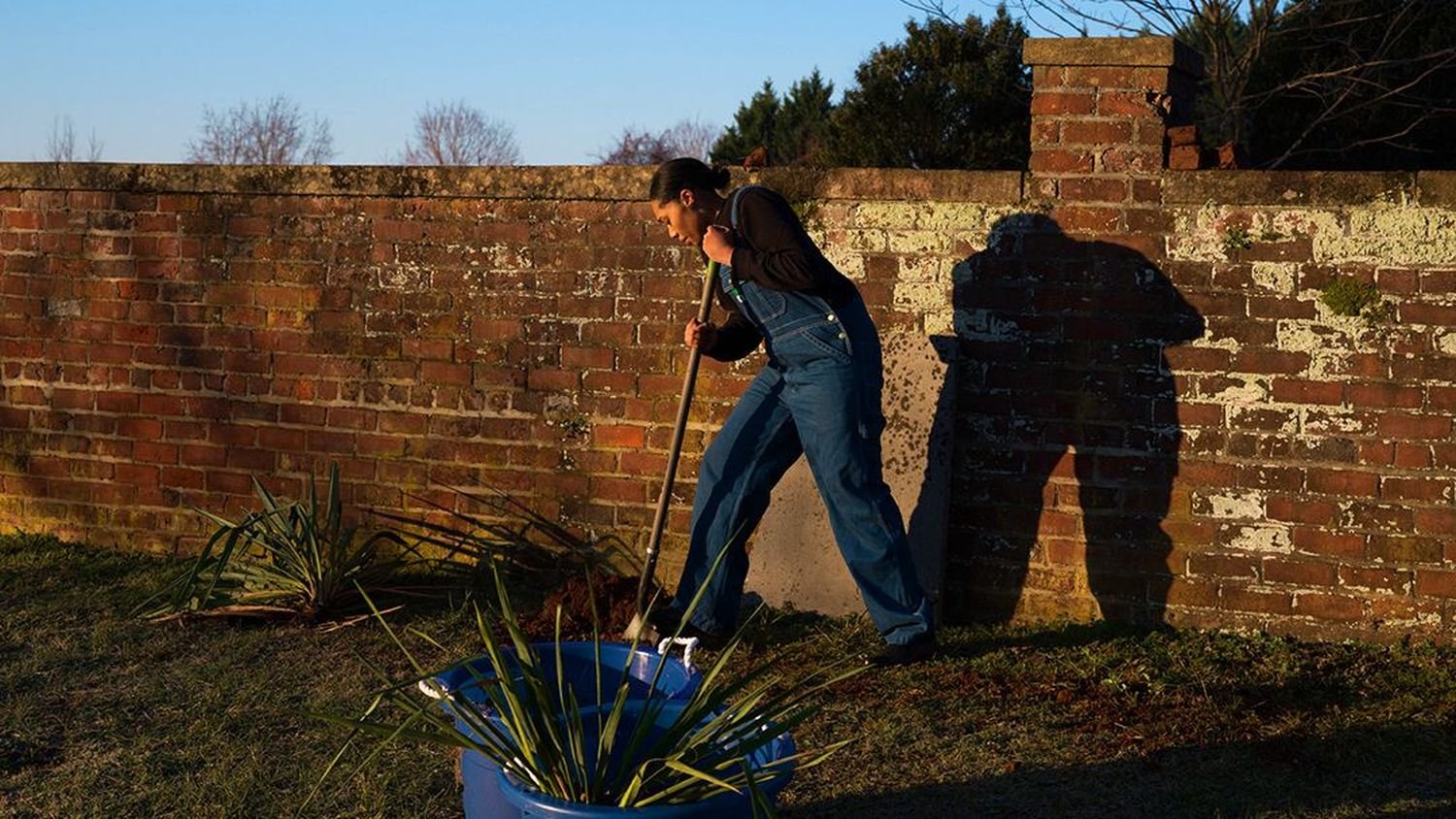
Though LaRissa works with memory and what it means to memorialize, she refuses to specularize death in her art. Moving away from Western ideologies of passive permanence and legacy, she seeks to explore memory as an active process – one that requires continuous confrontation and care. At the center of her recent works is the memory and presence of her great-grandmother. The yucca she plants traces its histories back to her great-grandmother’s garden: “That yucca plant ended up being this archive of her resilience and our relationship, but also required me to care for it... What does it mean to care for this soil or this plant that was never given this tenderness or care when it was alive or living?” LaRissa proposes an alternative memorial, transforming memory from something passive and erased to something that requires confrontation and interaction everyday – something living.

Exploring Materials
-
WTJU: You're listening to WTJU Charlottesville. We talked to Larissa Rogers for a new COVID-19 arts exhibition titled, “We Hope This Art Finds You Well.” Larissa talks about leaning into site-specific work during the pandemic.
LARISSA ROGERS: So I was outside a lot, and I think that's what really kickstarted a lot of the work that I made in it last year, was thinking about the landscapes, those histories, memorializing our monuments and what they imply about what it means to exist or remain is not true to what it means for a person of color or a black person within that space because like we're like living archives, we're representation of that survival, right? Just being an existence in that space. So that's been something that has been really great about being more site-specific, being within these landscapes, and how my practice has really transformed throughout COVID and then also like moving forward.
Monuments, Amnesia, and Memory

Charlottesville, already swirling in questions of monuments, history, and white supremacy, became a prime focus for LaRissa’s inquiry upon her return. Born and raised in Charlottesville, the towering symbols to racist, systemic violence were so deeply rooted in the sites and spaces that they became commonplace – speaking to a tradition of forgetting and erasing painful and painfully present histories.
Confronting the erasure embedded in collective memory, LaRissa works in site-specific meanings. As a radical act of resistance and healing, she practices self-care on the Richmond Slave Trail. As an ode to the memory of ancestors, she forms her silhouette out of the soil from Farmington Country Club and Pen Park, former plantation sites turned golf courses.
-
WTJU: You're listening to WTJU Charlottesville. We talked to Larissa Rogers for a new COVID-19 arts exhibition titled, “We Hope This Art Finds You Well.” Larissa shares how one particular plant was foundational to her practice.
LARISSA ROGERS: One thing that I think was transformational in my work was my great grandmother. And I think that you could really see in the performance that I did at Penn Park because the yucca that I was planting were from her garden. Like my great grandma, a lot of her belongings were burnt in a house fire, so I don't really have anything. And so that yucca plant ended up being kind of like this archive, not only of like her resilience, but also required me to like care for it as she's like passed away and kind of like thinking through that plant as an alternative heirloom. What does that mean? And if I can repropagate it, what does that mean?
-
WTJU: You're listening to WTJU Charlottesville. We talked to Larissa Rogers for a new COVID-19 arts exhibition titled, “We Hope This Art Finds You Well.” During a year that boasts a pandemic, an uprising, and continuing uncertainty, Larissa reminds herself of the importance of community and how rest can be a form of resistance.
LARISSA ROGERS:I think a lot of the work and the cultural work happening was on the ground, right? It was like in the community at these protests, but also leaving room for like slowing down. Rest is inherently resistance because we live in such a capitalistic society that teaches us that we always have to be on the go and making a moving and generating income. And so like also allowing myself to like rest. I mean, like you don't have to be productive.Part of your practice is literally just like being surrounded by these people, just taking in their energy and observing.